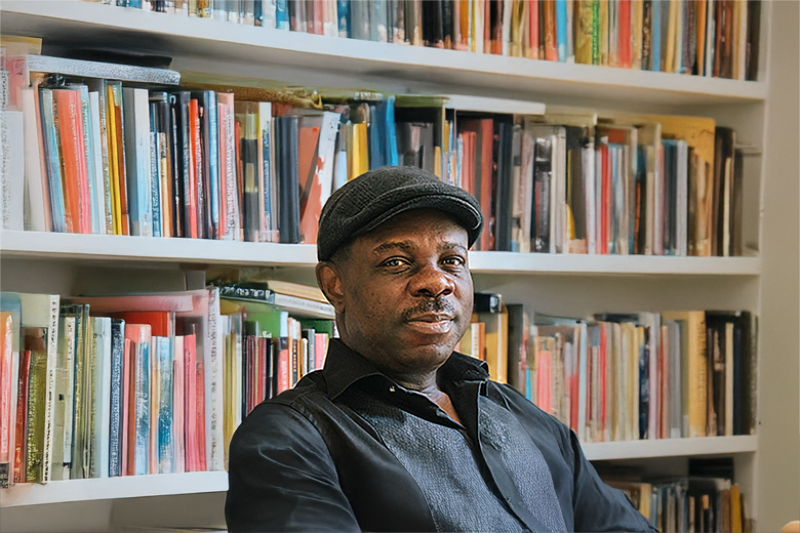
Maik Nwosu, professor and chair in DU’s Department of English and Literary Arts, grew up in southeastern Nigeria. Dr. Nwosu worked as a journalist in Nigeria for over eleven years before coming to the U.S. on a scholarship for a doctoral program in English and Textual Studies at Syracuse University. Since joining DU in 2006, he has conducted research about postcolonial and Nigerian literature, written novels and short stories, and taught a range of courses, including many about Africa.
In an interview, Dr. Nwosu described his linguistic background: “There are three languages in my family: pidgin English, Igbo language, and then the standard English. But it’s mostly pidgin English.” Since Nigeria has over 200 languages, it is common for people to communicate in pidgin English while a more formal English is taught in schools. Dr. Nwosu continues to negotiate these languages even as a U.S. immigrant; his wife speaks Yoruba and Igbo, but pidgin English is usually the most natural way for them to communicate.
Nigeria’s unique linguistic background has posed a dilemma for creative writers who must decide whether to write in native languages or to use the colonial language, English: “One of the great debates of African literature, especially in the 60s and 70s, was the question of what language an African writer should write in.” This dichotomy is a current topic of Dr. Nwosu’s research: “I'm looking at the connections that possibly exist between Igbo literature, or literature produced by Igbo writers in Igbo language, and literature produced by Igbo writers in the English language... One is closer to oral performance…one has been mediated by the culture of writing. I argue that there are connections, in terms of structure for instance, between these different kinds of writing.”
As Dr. Nwosu discusses in his influential study The Comic Imagination in Modern African Literature and Cinema: A Poetics of Laughter, Nigerian authors who write in English often incorporate “transliteration artifacts” in their work. For example, an Igbo author writing in English may insert an Igbo word at a key point in a narrative. Ụgbọala, for instance, “literally means land boat or canoe, which was the way Igbos described automobiles when they first saw them.” Examples like this one “are taken from the point of initial contact between European culture and African culture.” Language “made that contact difficult…and sometimes unintentionally comic.”
In his story collection Return to Algadez, Dr. Nwosu also engages with translingualism. He writes of “the endless road where the companions of the wayfarer are the multilingual elements.” Within the narratives, Dr. Nwosu uses inserted Igbo words to make readers engage with concepts that defy translation. A case in point is the word “gbam:” “Here, gbam is like an act of finality. It’s settled. It's fixed. I don't know how you translate that to English. I mean, you could- but it doesn't quite have the same sort of bang or effect that it has in Igbo language.” This is the type of word that a reader unfamiliar with the language can figure out from context: “Unless I believe that the Igbo word is going to be very difficult to figure out, I will leave it there untranslated.”
Language is also central to Dr. Nwosu’s first novel Invisible Chapters where “most of the conversation is in pidgin English.” A recurring word in this novel is tokunbo, a Yoruba word “that we use in Nigeria to also refer to secondhand things.” For example, “the trade in tokunbo cars and tokunbo dresses and tokunbo- all the things that we import that have been pre-owned or used.”
While the question of which language to use and which translingual elements to incorporate has been at the forefront of Nigerian writers’ consciousness, Dr. Nwosu finds it important that whatever its linguistic instantiation, the engagement with culturally rooted folktales and myths often remains constant. For instance, Nigerian writers continue to retell classic Igbo narratives such as the story of champion wrestler Ojadili who goes to the land of the spirits but cannot defeat his chi, or guardian spirit: “The idea of the connection between the known world and the unknown world, the world of the dead and the world of the living, is all part of that dramatization. The story integrates a lot of cultural attributes. Whether in Igbo or in English, the stories seem to draw from the same source.”
As a professor at DU, Dr. Nwosu is encouraged by how much the interest in different languages and cultures has grown in the twenty years that he has worked here: “In the last three quarters, I’ve done a class on Africa every quarter. I couldn’t do that when I first got here.” Dr. Nwosu encourages DU to continue recruiting students and faculty of color and to remain committed to building the intellectual diversity of the campus. “We still need a more diverse academic environment.” As a teacher, scholar, and creative writer with unique insights about postcolonial, transnational, and translingual experiences, Dr. Nwosu has long played an inspirational role in fostering intellectual diversity at DU.