About Clark STEM WSI
Welcome to the Clark Foundation STEM Writing Support Initiative. This is our online resource site that is meant to serve the writing needs of STEM faculty and students. Here you will find curated STEM writing support resources for students and writing pedagogical resources for STEM faculty.
Write to Dr. Nancy Sasaki, Project Manager of the Clark Foundation STEM Writing Support Initiative, at nancy.sasaki@du.edu or Dr. Olivia Tracy, Writing Center Assistant Director, at wrc@du.edu to explore options.
Spotlight on DU Faculty Writing Across the Curriculum
-
Dr. Robin Tinghitella & Dr. Shannon Murphy
Science Communication and Science Writing -
Two Science Courses Flip the Script on Students Making them the Subject Matter Creators
By Nancy Sasaki, PhD
If you are an undergraduate student in the STEM disciplines, typically the writing-intensive experiences are part of the common curriculum and are completed upon successfully taking the two writing and rhetoric courses. Two faculty members in biological sciences believe that writing should not only be part of the student’s common curriculum, but also part of the biology major.
Most courses across STEM are centered on increasing student knowledge of science content related to their major or minor. Two courses in the Department of Biological Sciences place the student in a different position: one of a science communicator. Drs. Robin Tinghitella and Shannon Murphy have designed two intensive writing courses for both graduate and undergraduate students in biology that challenge students to interact with scientific information in a new way, one that requires presenting scientific information to a broader audience. This audience may be a granting agency, a peer, a future employer, a roommate, or perhaps even a family member. Why is science communication so important? Let’s see what two biologists have to say about that.
When asked what inspired Dr. Robin Tinghitella to design a science communication course as part of the electives in the biology curriculum, she said it was for a variety of reasons. “Science is necessary to effectively address things like environmental change, new technologies, and even equity issues. Yet segments of society doubt science and distrust scientific information—and even scientists themselves. To overcome this grand challenge, we need effective science communication to enhance public support and trust in science.” Dr. Tinghitella designed her course with a student-centered approach. After an introduction to the vast literature on scientific communication, students then develop community-engaged projects involving real audiences, supported by peer feedback. These experiences are meant to capitalize on and enhance students’ understanding of their own scientific knowledge and background.
Scientific writing is the second intensive writing course. This course is focused on writing for the scientific community, but it also includes time for students to explore their own practice of writing. The students taking this course are at some stage of preparing a thesis as part of their graduation requirements and use a portion of their thesis as the context for assignments completed during the class. Dr. Murphy structured the course to allow students not only the time to create and write in class, but also to understand how to manage a writing project. “Most students believe they can write something brilliant overnight and usually fail to leave time for revision. In this course, students learn about the iterative process of revision through multiple drafts and peer review from classmates to improve clarity, but also to improve the accessibility of their work to scientists in all fields.” The objective is for each student to finish the course by completing at least one part of their thesis, but more importantly for students to gain transferable writing practices that help inform future writing situations.
While these two writing courses serve different purposes and focus on different scientific writing genres, a common goal that both professors share in their classes is helping students learn and practice a variety of writing practices that would be valuable whether they remain in science or choose to pursue a different career.
-
Dr. Debbie Gale Mitchell
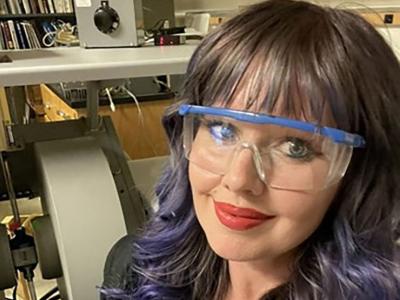
Learning to Write for a Public-Facing Audience: A Chemistry Professors Writerly Journey
by Nancy Sasaki, PhD
Since teaching her Chemistry + Art first year seminar class in 2016, Dr. Debbie Gale Mitchell, a chemistry teaching professor, began to recognize a significant gap in public-facing science writing: there was no accessible, comprehensive account of how light interacts with matter across the full spectrum of spectroscopy. While popular books on visible light and color were available, they tended to isolate narrow phenomena rather than present spectroscopy as a unifying scientific framework that underpins technologies ranging from medical imaging to climate science. This realization marked the beginning of Dr. Mitchell’s transition from disciplinary expert to public science writer.
Dr. Mitchell’s commitment to accessible science communications, however, predated her current book project. Beginning in 2014, she used social media platforms such as Twitter (and later Instagram and TikTok) to share accurate chemistry information in approachable, creative ways. Her posts blended chemistry with everyday practices, including makeup application and bullet journaling as a strategy for countering widespread scientific misinformation to help increase chemistry literacy among general audiences. One post that connected spectroscopy principles to cosmetic pigments reached over one million views, underscoring both the public interest for accessible science and the effectiveness of integrating disciplinary knowledge with familiar everyday practices (such as putting on makeup). These experiences ultimately shaped her decision to pursue what would become her most ambitious scholarly writing project: a nonfiction chemistry book for a general audience.
At the beginning of 2021, Dr. Mitchell began drafting an initial version of her spectroscopy manuscript. After about a year of trying to write on her own, she joined a Writing Accountability Groups (WAGs) led by DU writing professor Dr. Geoff Stacks. WAGs are facilitated, small-group writing communities designed to support faculty productivity, work–life balance, and sustained engagement with scholarly or creative projects. Dr. Mitchell credits this experience as a turning point in her development as a writer, “The experience … gave me the confidence to keep going.” Interestingly, she recalls Dr. Stacks’s observation that committed readers already possess foundational writing expertise as helping to reframe her identity as a “scientist who writes” to “writer who practices science.” This insight also encouraged Dr. Mitchell to become a more confident writer.
Building on this momentum, Dr. Mitchell participated in additional WAGs lead by writing faculty Dr. Kara Taczak, Olivia Tracy, and Megan Kelly. She describes these groups as instrumental in helping her maintain steady progress and accountability across multiple academic quarters. Complementing this work, she also took part in writing workshops hosted by Lighthouse, a community-based organization offering faculty-led workshops for writers at all stages. Together, these writing communities provided not only structural support but also a space for reflection and experimentation and also figuring out more about her writerly identity as public-facing scientific writer. Mitchell continues to use the Writing in Place (WIP) opportunities supported through the Writing Program to continue the final stages of publishing her book.
By spring 2023, Dr. Mitchell had completed five sample chapters, enabling her to secure a literary agent. Her book proposal, Resonance & Radiance: How Light Reveals the Chemistry of Our World, was acquired by MIT Press in March 2024 and is currently in the editorial stage, with a projected publication date of March 2027. Reflecting on her motivations for undertaking such an extensive project, Dr. Mitchell explains that she hopes readers will gain insight into how scientific knowledge is produced and applied from understanding air quality indices and MRI technologies to tracking rising atmospheric carbon dioxide levels. At its core, the book seeks to demystify spectroscopy and make its relevance visible to communities beyond the academy.
What began as an effort to counter scientific misinformation on social media has thus evolved into a sustained scholarly writing project and a new mode of academic engagement. For Dr. Mitchell, this journey represents not only the expansion of her disciplinary teaching into public scholarship but also the formation of a supportive, interdisciplinary writing community and a renewed understanding of writing as an integral component of scientific practice.
Student Writing Resources and Support
These resources are designed to provide a comprehensive list of writing resources tailored specifically for students in STEM (Science, Technology, Engineering, and Mathematics) fields. It aims to assist STEM students in honing their writing skills and mastering the art of conveying complex technical information clearly and effectively. Each information block on this page offers easy-to-access guidance on how to write specific technical documents. such as the scientific research paper, lab report, thesis, or any other technical document. The resources cover a wide range of topics, from formatting requirements to tips on effectively communicating scientific findings.
- Writing an Introduction to Lab Reports
- Writing a Methods Section of Lab Reports
- Writing a Results Section of Lab Reports
- Writing a Biology Literature Review
- Writing Personal Statements
- Footnotes & Endnotes in STEM Writing
-
Research Poster Support
To talk about whether the Writing Program can host an interactive workshop on poster design and print research posters for a small fee, please write to Writing Program Manager Amanda Thompson at writing@du.edu.
STEM Faculty Resources
-
Reading Resource Materials for STEM Writing
Archila, P. A., Molina, J., & de Mejía, A. M. T. (2018). Fostering bilingual scientific writing through a systematic and purposeful code-switching pedagogical strategy. International Journal of Bilingual Education and Bilingualism.
Balgopal, M. M., Casper, A. M. A., Wallace, A. M., Laybourn, P. J., & Brisch, E. (2018). Writing matters: Writing-to-learn activities increase undergraduate performance in cell biology. BioScience, 68(6), 445-454.
Beer, D. F., & McMurrey, D. A. (2019). A Guide to Writing as an Engineer. John Wiley & Sons.
Brackenbury, T., William Folkins, J., & Ginsberg, S. M. (2014). Examining educational challenges in communication sciences and disorders from the perspectives of signature pedagogy and reflective practice. Contemporary Issues in Communication Science and Disorders, 41(Spring), 70-82.
Berdanier, C. G. (2019). Genre maps as a method to visualize engineering writing and argumentation patterns. Journal of Engineering Education, 108(3), 377-393.
Brownell, S. E., Price, J. V., & Steinman, L. (2013). Science communication to the general public: why we need to teach undergraduate and graduate students this skill as part of their formal scientific training. Journal of undergraduate neuroscience education, 12(1), E6.
Carpenter, J. H. (2011). A “layered literacies” framework for scientific writing pedagogy. Currents in Teaching and Learning, 4(1), 17-33.
Conrad, S. (2018). The use of passives and impersonal style in civil engineering writing. Journal of Business and Technical Communication, 32(1), 38-76.
Dannels, D. P. (2001). Time to speak up: A theoretical framework of situated pedagogy and practice for communication across the curriculum. Communication education, 50(2), 144-158.
DeTora, L. (2021). Competing mentalities: Situating scientific content literacy within technical communication pedagogy. Effective teaching of technical communication: Theory, practice, and application, 271-285
Ding, D. (2001). Object-centered—How engineering writing embodies objects: A study of four engineering documents. Technical Communication, 48(3), 297-308.
Herrington, A. J. (1985). Writing in academic settings: A study of the contexts for writing in two college chemical engineering courses. Research in the Teaching of English, 19(4), 331-361.
Hutto, D. (2007). Graphics and invention in engineering writing. Technical communication, 54(1), 88-98.
Jane Burke, P., & Dunn, S. (2006). Communicating science: exploring reflexive pedagogical approaches. Teaching in Higher Education, 11(2), 219-231.
Kroll, J. (2013). The creative writing laboratory and its pedagogy. Research methods in creative writing, 102-132.
Kuhn, M. R., & Vaught-Alexander, K. (1994). Context for writing in engineering curriculum. Journal of professional issues in engineering education and practice, 120(4), 392-400.
MacKenzie, A. H., & Gardner, A. (2006). Beyond the lab report: why we must encourage more writing in biology. The American Biology Teacher, 68(6), 325-327.
McKenna, B. (1997). How engineers write: An empirical study of engineering report writing. Applied linguistics, 18(2), 189-211.
McVey, M., & Pechenik, J. A. (2020). Using poetry in the undergraduate biology classroom. The American Biology Teacher, 82(6), 416-420.
Mehltretter Drury, S. A., Bost, A. G., Wysocki, L. M., & Ingram, A. L. (2018). Encouraging science communication through deliberative pedagogy: A study of a gene editing deliberation in a nonmajors biology course. Journal of Microbiology & Biology Education, 19(1), 10-1128.
Motta-Roth, D., & Scherer, A. S. (2016). Science popularization: Interdiscursivity among science, pedagogy, and journalism. Bakhtiniana: Revista de Estudos do Discurso, 11, 164-189.
Simis, M. J., Madden, H., Cacciatore, M. A., & Yeo, S. K. (2016). The lure of rationality: Why does the deficit model persist in science communication?. Public understanding of science, 25(4), 400-414
Smith, M. K., & Knight, J. K. (2020). Clickers in the biology classroom: Strategies for writing and effectively implementing clicker questions that maximize student learning. Active learning in college science: the case for evidence-based practice, 141-158.
Sprain, L., & Timpson, W. M. (2012). Pedagogy for sustainability science: Case-based approaches for interdisciplinary instruction. Environmental Communication: A Journal of Nature and Culture, 6(4), 532-550.
Taylor, K. L. (1998). Writing in biology: an integration of disciplines. The American Biology Teacher, 60(5), 350-353.
Thompson, N. S., & Alford, E. M. (1997). Developing a Writing Program in Engineering: Teaching Writing to Teach Engineering Literacies.
Vázquez, A. V., McLoughlin, K., Sabbagh, M., Runkle, A. C., Simon, J., Coppola, B. P., & Pazicni, S. (2012). Writing-to-teach: A new pedagogical approach to elicit explanative writing from undergraduate chemistry students. Journal of Chemical Education, 89(8), 1025-1031.
Walker, K. (2000). Integrating writing instruction into engineering courses: A writing center model. Journal of Engineering Education, 89(3), 369-375.
Winsor, D. A. (2003). Writing power: Communication in an engineering center. Suny Press.
Wright, K., Slaboch, P. E., & Jamshidi, R. (2022). Technical writing improvements through engineering lab courses. International Journal of Mechanical Engineering Education, 50(1), 120-134.
Yoritomo, J. Y., Turnipseed, N., Cooper, S. L., Elliott, C. M., Gallagher, J. R., Popovics, J. S., … & Zilles, J. L. (2018, June). Examining engineering writing instruction at a large research university through the lens of writing studies. In 2018 ASEE Annual Conference & Exposition.
-
STEM Writing Pedagogical Resources
Link to videos in DU MediaSpace
-
How can I encourage my students to visit the Writing Center?
The Writing Center is part of the Writing Program, which offers extensive resources for faculty teaching writing across the curriculum:
- STEM trained Writing Consultants
- Writing accountability groups
- Pedagogical / teaching resources
-
What kind of support will my students get when they visit?
The Writing Center staff is primarily made up of peer consultants: graduate and advanced undergraduate consultants from across a range of humanities, social science, and STEM fields.
What your students will experience is a non-evaluative and inquiry-based conversation about their work with a peer consultant.
Peer consultants should not be considered experts, and they don't assess, correct, or check work. Rather, they ask questions, offer perspectives, identify relevant resources, help identify opportunities for revision, and work to support students in editing and revising their own work.
We suggest you frame writing center appointments as an opportunity for students to work on their writing with a consultant, rather than as an opportunity to get feedback or guarantee quality. Writing Center consultations are aimed at promoting learning and helping writers to do the work of developing their writing skills and processes.
-
How will I know if a student goes to the Writing Center?
Our consultants write a short note after each session and email that note to the writer. Your students can simply forward that email to you; alternately, if they provide your name and email address to their consultants, we can send that email directly to you.
We do count on students to provide your contact information and to give us permission to contact you.
-
Can I require my students to visit the Writing Center for a particular assignment?
Most likely yes, as long as you work with us to support those visits.
We are happy to work with you to arrange for all your students to visit the Writing Center to work on a particular assignment. To make this visit as effective as possible, we will ask you a few questions about your class, your students, and the assignment in advance. Please note that we cannot promise to accommodate required visits unless we are involved in the planning. (Two weeks' notice required, available in weeks 3-9 only.)
If our schedule is unable to accommodate individual visits, we can set up paired or small-group visits or set aside some dedicated writing studio hours for your students to work on their projects and ask questions of consultants.
If you would like to arrange for your students to work with Writing Center consultants for required/incentivized appointments, please contact us at wrc@du.edu at least two weeks in advance to discuss options. Please send your course name and number, the number of enrolled students, and a copy of the assignment and due date.
-
What can a writing consultation do and not do?
Writers who visit us online will participate in an interactive, collaborative discussion about their papers with peer consultants, who will help to set goals, generate strategies, and identify resources; ask questions about assignment prompts and previous feedback; and help students to learn new skills and concepts.
Our consultants do not involve reviewing papers in advance or guaranteeing correctness. Consultants do not proofread or edit for students, mark up papers, or check citations.
Consultants can talk about and help students to do all of these things, but please note that the Writing Center is a learning site, and individual students retain agency and responsibility for their learning and writing choices.