Math isn't Just for Chalkboards ... Sometimes it Blooms in the Garden!
By Dr. Mei Yin
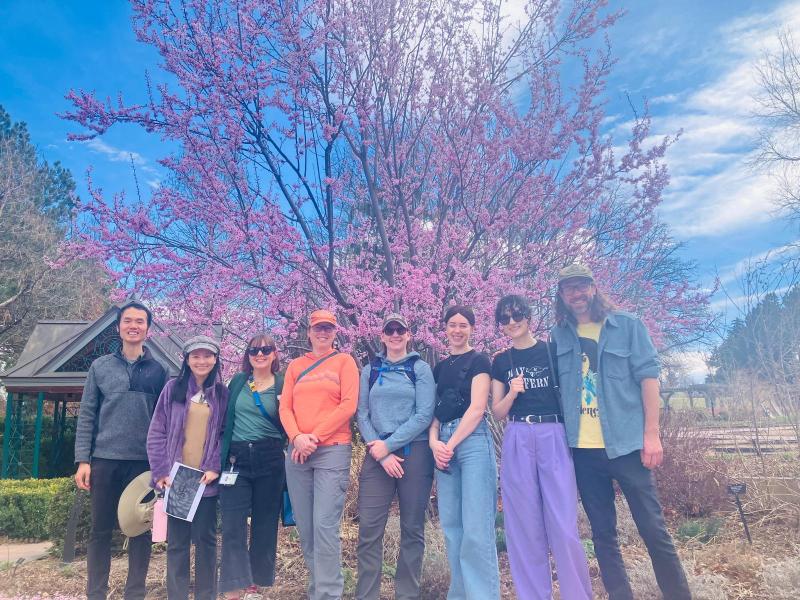
The Simons Foundation has been a generous supporter of my current research in mathematics, and that support also opened the door to exciting opportunities in public engagement. Last fall, I was contacted by Elizabeth Simolke, Senior Program Manager of Science, Society & Culture at the Simons Foundation, who invited me to participate in their year-long Infinite Sums initiative (https://infinitesums.simonsfoundation.org/), which aims to connect communities across the United States with opportunities to engage with math through cultural experiences. Elizabeth encouraged me to build a local network of like-minded math ambassadors—people who are passionate about sharing mathematics with the public in meaningful and accessible ways. This aligned with my strong belief that DU is Denver’s University, so I was immediately drawn to this idea and happily said yes!
Through Elizabeth, I was introduced to Hannah Craft, Associate Director of Learning Engagement & Interpretation at the Denver Botanic Gardens, along with her talented team. Together, we are having a Math in Bloom year (https://www.botanicgardens.org/events/special-events/math-bloom-presents-pi-day) at the Denver Botanic Gardens—a series of events and activities designed to showcase the deep and often surprising connections between mathematics and the natural world. The setting could not be more fitting: a botanical garden is full of living examples of mathematical structure and pattern. Indeed, mathematical ideas are woven throughout nature, from the spiraling arrangements of sunflower seeds that follow Fibonacci sequences to the appearance of the golden ratio in leaf and petal configurations.
One of the highlights of this initiative so far was our public-facing Pi Day event, held on March 14. Pi, one of the most well-known constants in mathematics, has long served as a gateway for people to appreciate the beauty and universality of math. For this event, Hannah and I were joined by two of my colleagues, Anh Le (DU) and Ben Dyhr (MSUD). Together, we led guided tours through the gardens, inviting visitors to explore mathematics not through equations on a page, but through direct observation of the world around them. During these tours, participants engaged in hands-on and interactive activities that revealed mathematical patterns hidden in plain sight. We examined pinecones to uncover Fibonacci sequences, counted petal arrangements that often align with these same numerical patterns, and discussed how the concept of pi emerges naturally in circular forms such as flowers and tree rings. We also highlighted fractal-like branching structures in trees, showing how simple mathematical rules can generate complex and beautiful forms.
The response from the public was overwhelmingly positive. Many participants expressed surprise at how accessible and engaging mathematics could be when presented in this context. Events like this reinforce the idea that math is not an abstract or distant discipline, but rather a fundamental lens through which we can better understand and appreciate the natural world. Through the Infinite Sums initiative supported by the Simons Foundation, we hope to continue building bridges between mathematics and the broader community, inspiring curiosity and wonder in audiences of all ages.
By participating in the Center for Community Engagement's "Presenting with Purpose" workshop through the Community of Practice, I honed my public speaking skills. I am grateful to Cara DiEnno, Anne DePrince, John Macikas, and Anastasiya Bolton for their invaluable support!